Promoting Civic Discourse in North American Library Systems
Thriving, multiracial democracies rely on vibrant public spaces—places where people can gather, connect, and engage in meaningful dialogue. Yet across the United States, a range of forces has weakened the foundation of civic life: deep social and economic divides, political polarization, declining trust in institutions, and fewer spaces where communities can come together across differences. To counter these trends, researchers and community leaders alike emphasize the need to build the capacity of grassroots leaders, expand inclusive civic spaces, and promote local participation that fosters connection and understanding.
Public libraries—present in nearly every community across North America—are uniquely positioned to advance these efforts.
To help reverse this trend, the Urban Libraries Council (ULC) has launched a new initiative: Promoting Civic Discourse in North American Library Systems, in partnership with Everyday Democracy. This work is made possible through a multi-year $182,000 grant from the American Arbitration Association–International Centre for Dispute Resolution (AAA-ICDR) Foundation.
Together, the Urban Libraries Council and Everyday Democracy are training 50 library leaders in multi-partial facilitation—a dialogue approach that promotes balance, equity, and inclusion by encouraging multiple viewpoints, addressing power imbalances, and challenging dominant narratives.
The goal is to strengthen community bonds and create more inclusive, participatory public spaces. Trained librarians will go on to host community conversations in up to 12 cities across North America, engaging more than 300 participants in thoughtful dialogue on pressing local issues.

Promoting Civic Discourse in Public Libraries: Lessons Learned from ULC's 2025-2026 Initiative
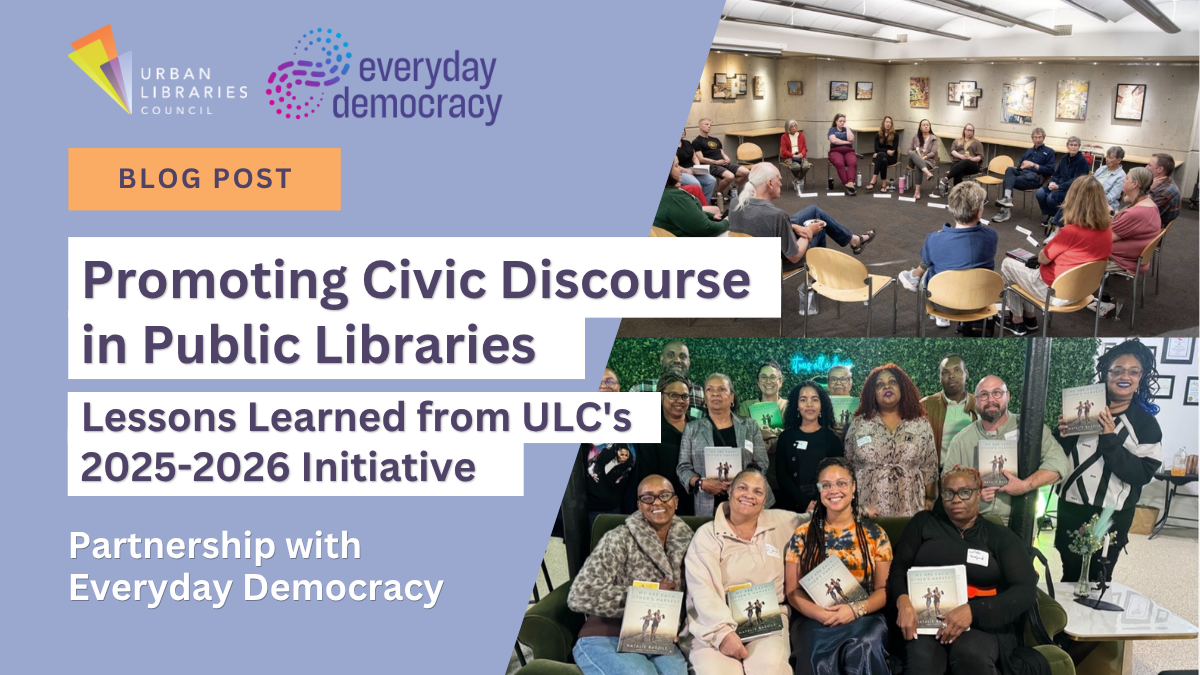
In a world with increasing partisan division and civic disconnect, libraries serve as vital community gathering places where residents can meet across difference and find commonality. Libraries have always served as these third spaces – free, accessible locales for spending time that are neither home nor work. However, in a rapidly changing and often charged culture, library staff need new skills for fostering rich community engagement, bridging divides, and lifting otherwise unheard or marginalized voices in vital conversations. That’s where Urban Libraries Council’s partnership with Everyday Democracy came in.
Article Excerpt: "How Libraries Are Rebuilding Civic Connection: A Civic Engagement Story"
Published by Everyday Democracy
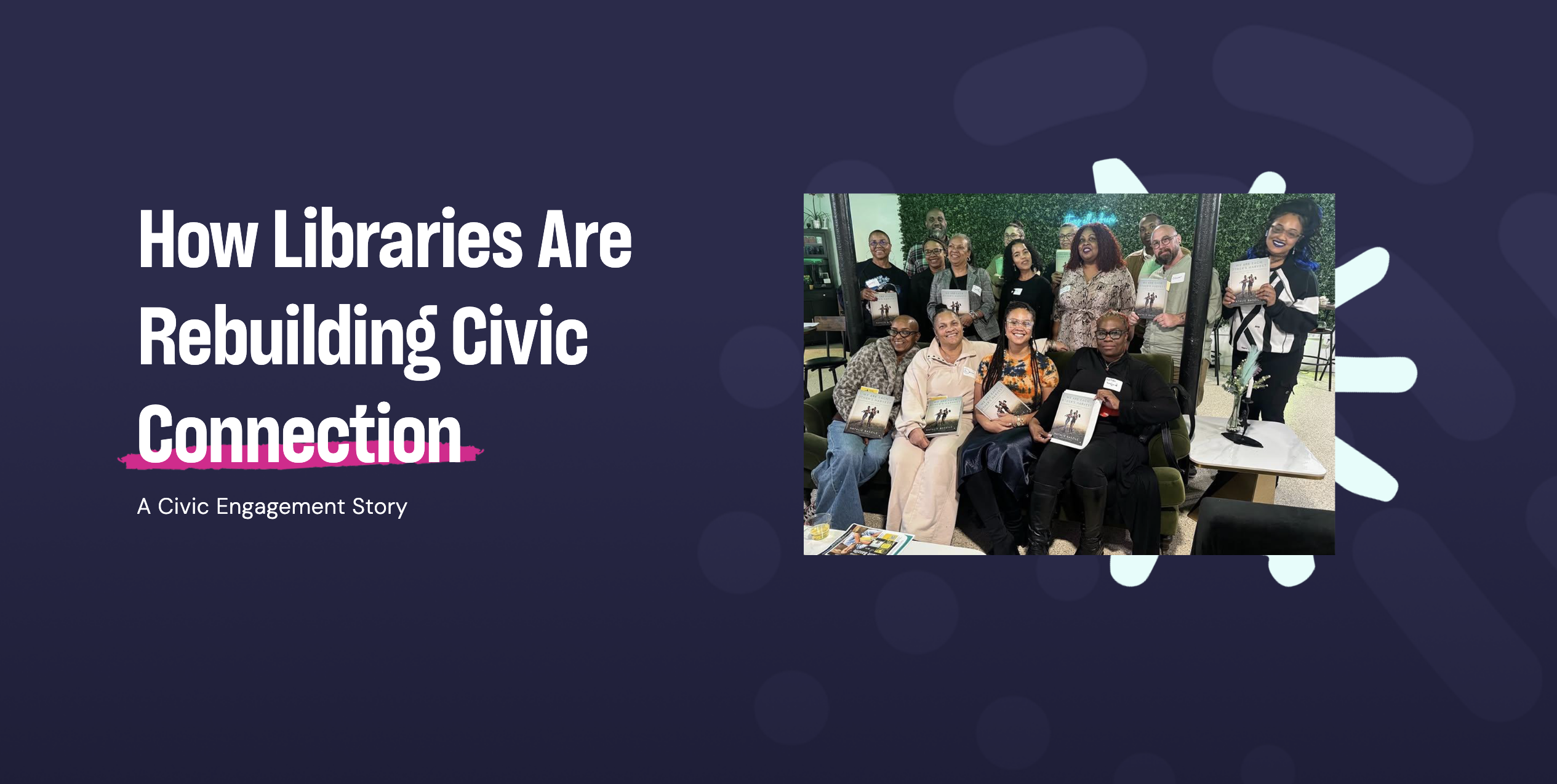
In his pocket, Oscar carried a small guide from Everyday Democracy’s multipartial facilitation training—his “cheat sheet,” as he called it. Over the past several months, he had joined library leaders from across North America in a partnership between Everyday Democracy and the Urban Libraries Council to learn new ways of leading community conversations across difference that build connection and increase civic participation. Multipartial facilitation centers voices and experiences that are often unheard or excluded, helping communities move through difficult conversations with greater understanding, balance, and trust.
Oscar and his colleagues designed their event intentionally. They partnered with community organizations, hosted the discussion in a free co-working space in the city’s Black Arts and Culture District, and brought in a co-facilitator from the community.
What unfolded surprised him.
Neighbors listened deeply to one another. Participants who had never met shared painful family histories of dispossession and displacement, sometimes bringing photographs, heirlooms, and personal artifacts into the conversation. Stories about the past opened pathways to understanding present-day housing inequities and gentrification in San Diego.
Read San Diego Public Library's Multipartial Facilitation Story“It was unlike any program I’d ever done. I was unprepared for the connection I’d have and the shared responsibility that I’d feel.”
Oscar Gittemeier, San Diego Public Library

What is Multipartial Facilitation?
As part of this project, ULC and Everyday Democracy will train 30-50 librarians in multipartial facilitation, a dialogue approach that promotes balance, equity, and inclusivity by encouraging multiple viewpoints, addressing power imbalances, and interrupting dominant narratives.
Multipartiality gives attention to multiple identities and experiences, especially ones that might be left out or historically unheard. In dialogues, this can balance power disparities and enhance learning and understanding.