
Skip Navigation
Back to Navigation

Civic Makers Lab for Youth (15-18)

Overview

The Civic Makers Lab for Youth (15-18) is a coordinated network of Carnegie libraries that will empower young people to practice democracy and lead community change. Participating libraries will offer hands-on civic learning experiences that complement school education, and partner with community organizations and families to deepen civic impact.

In addition to deploying local programming, participating library staff will take part in monthly virtual learning sessions with national experts in civic education and media literacy, two in-person events, and additional peer-learning opportunities. These professional development opportunities will ensure that libraries have the capacity and confidence to sustain civic programming beyond their pilot.

Congratulations to These 10 Selected Libraries!
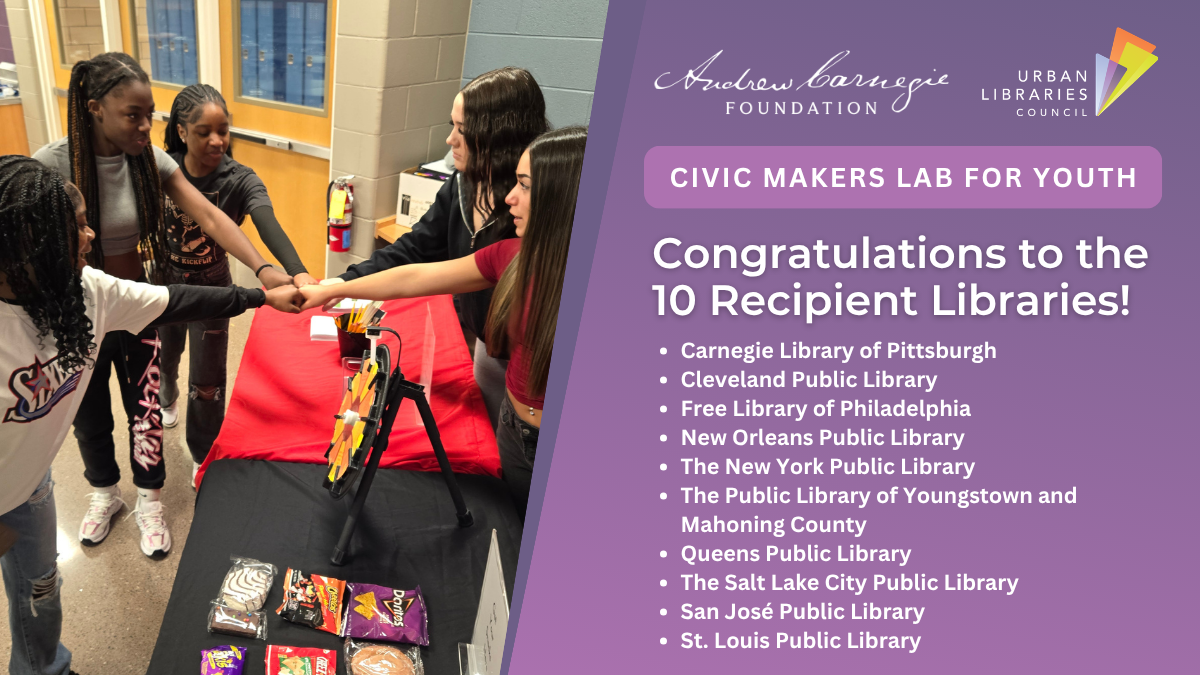
CML4Y_SelectedLibraries_TW.png

The Urban Libraries Council (ULC) is proud to announce the 10 participating member libraries for itsCivic Makers Lab for Youth (15-18) project, made possible by a generous grant from the Andrew Carnegie Foundation, formerly Carnegie Corporation of New York.

The 10 ULC members selected, all with Carnegie branches, are:

  • Carnegie Library of Pittsburgh
  • Cleveland Public Library
  • Free Library of Philadelphia
  • New Orleans Public Library
  • The New York Public Library
  • The Public Library of Youngstown and Mahoning County
  • Queens Public Library
  • The Salt Lake City Public Library
  • San José Public Library
  • St. Louis Public Library

Congratulations to our selected cohort!

Support for the Civic Makers Lab for Youth (15-18) was provided by a grant from the Andrew Carnegie Foundation.
Carnegie-Blue-Logo.png

Frequently Asked Questions

Is this program political?

No. The Civic Makers Lab focuses on civic skills such as dialogue, problem-solving, and collaboration — not ideology or partisanship.

Do I need to be a teen librarian to apply?

Teen librarians are a great fit, but any staff member committed to working with teens can participate.

What if our library has limited experience with youth programming?

That’s okay. We welcome libraries that want to build capacity and create new pathways to engage youth.

How will selections be made?

ULC will consider community need, staff capacity, partnerships, and willingness to commit to young adult civic development. We will also consider recent participation in another ULC cohort program.

What is the application timeline?

Applications are due on May 27, 2026. Selected libraries will be informed by June 30, 2026. The cohort program will begin for selected libraries in September 2026.

Do I need to know what type of program I want to launch?

No! Designing local programs will be part of the cohort process. This is why the application does not ask you to describe your prospective program.

Who from the library should be the program lead? And may multiple staff members participate?

The individual leading the day-to-day program is the best fit to participate, and this position will vary among library systems. We ask that you select a program lead who attends all meetings, but a small number of additional staff (up to 3) may attend meetings as well.

May our library foundation accept the award instead of the library itself?

Yes, as long as library staff will be performing the work associated with the project.

What types of expenses are allowable with the funds?

There will be a budget development process as part of the program, and we will work with you to ensure your budget will facilitate the most impactful program. The only concrete limitation is that funds cannot be used for alcohol. Otherwise, we ask that you follow your library’s internal guidelines for expenditures.

Are we required to do a particular kind of program? What are some examples?

No, there is no requirement to run one specific type of program. Libraries are encouraged to design experiences that fit their community, using simple, low-lift formats like community dialogues, civic workshops, youth advisory groups, or “meet your local leader” sessions. The focus is less on the format and more on creating participatory experiences that build civic knowledge, skills, and a sense of agency. For example, a library might host a discussion on a local issue, run a short workshop on how to engage with local government, or invite a public servant to share their work.