Wellbeing by Design: From Plan to Practice
Kitchener Public Library
Innovation Synopsis
Kitchener Public Library turned its 2025–2028 Strategic Plan into an actionable framework by adapting the Canadian Index of Wellbeing (CIW) into five locally relevant outcomes: Community Vitality, Good Health and Wellbeing, Leisure and Culture, Lifelong Learning, and Democratic Engagement.
The outcomes work in two directions: they guide program and service-location decisions, then organize quantitative and qualitative evidence about how spaces, staff, programs, collections and technology affect users. A shared dashboard and iterative feedback cycle return evidence to responsible teams, enabling the library to improve services while recognizing its influence on individual and community wellbeing.
Challenge/Opportunity
Board members and staff asked for focus: sharper priorities and a clearer connection between strategic commitments and daily work. Broad plans could express purpose without resolving competing needs; conventional measures such as visits, circulation and attendance showed activity but not what changed for people. Program categories overlapped, neighbourhoods expressed unequal barriers to service, and qualitative feedback was dispersed across teams. Kitchener Public Library needed one method that could focus planning and evaluation, preserve public-service expertise, connect counts with lived experience, and avoid claiming sole responsibility for community-wide change. The opportunity was to make wellbeing an actionable, repeatable framework that would align the organization, guide equitable resource choices and create a disciplined feedback loop from community experience to staff action.
Key Elements of Innovation
Shared lens: Cross-divisional managers adapted the Canadian Index of Wellbeing into five outcomes relevant to public-library service.
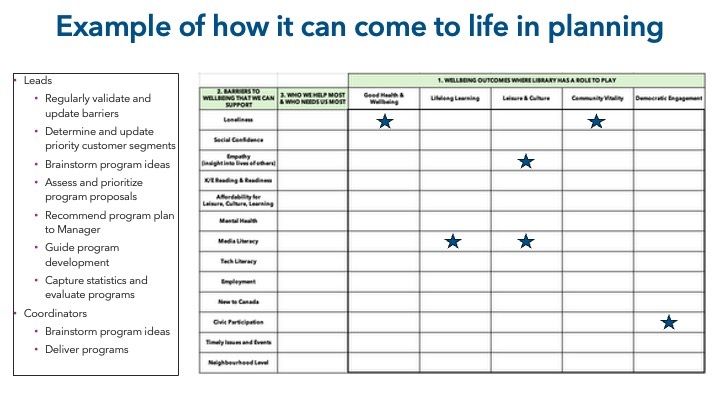
Development: Customer Impact’s “Programming for Impact and Equity” matrix links each priority to an outcome, barrier and population facing disproportionate risk.
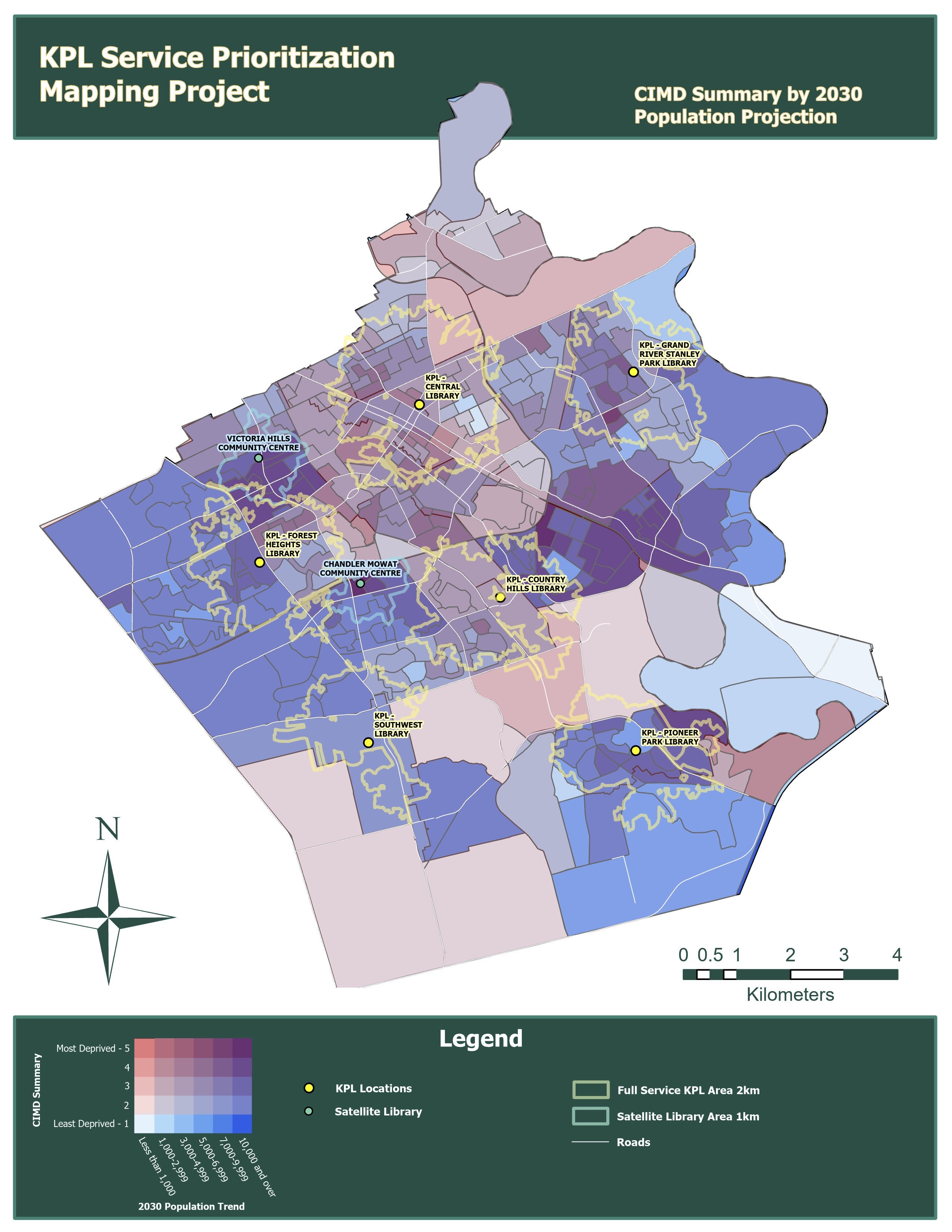
Customer Experience’s service-priority planning uses a model co-created with the University of Waterloo (UW) Future Cities Institute that layers access, growth, deprivation and literacy evidence.
Evaluation: KPL created the Organizational and Community Advancement (OCA) team to collect and analyze evidence across spaces, staff, programs, collections and technology, pairing use data and ratings with open-text surveys, interviews and testimony.
Feedback: Dashboards and Insight reports return findings to managers and teams through a human-centred design cycle: frame, listen, test, interpret and adjust.
The innovation is one shared lens used before and after service delivery.
Achieved Outcomes
Five wellbeing outcomes anchor program, location and performance planning; Team Projects and an integrated dashboard connect strategy, operations and stewardship.
In 2026, KPL offered fewer, more focused programs; average attendance per program rose while total attendance held steady.
KPL and UW’s Future Cities Institute completed a reusable neighbourhood model combining access, growth, 21 deprivation variables and school-literacy data.
OCA piloted wellbeing baseline surveys; survey and staff-feedback documented impact and actionable improvements.
Meeting-room users reported stronger social connection: “Our group couldn't have afforded a for-profit rental space, so we would not have been able to meet in person. …[we met] and left as friends.” A gear borrower wrote, “My filmmaking is fundamental to my wellbeing”; it “helps me maintain deep connections in the community.”
Findings return to teams, management and the Board; staff and managers affirmed the framework’s value.