Closing the Literacy Gap
St. Mary's County Library
Innovation Synopsis
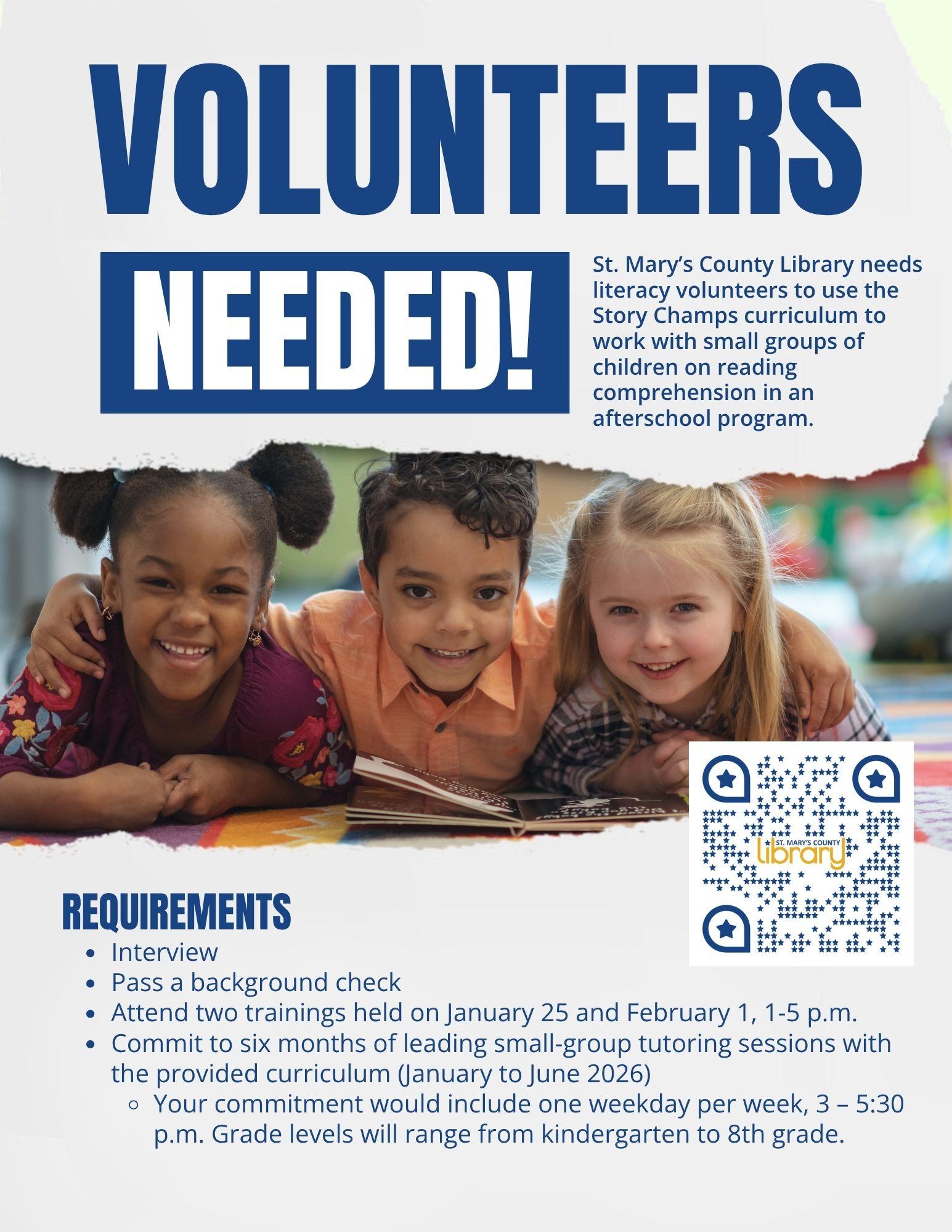
Many of our Title I area students are struggling to learn to read when they enter school. It takes time and lots of reading to develop the language comprehension skills needed to become fluent readers. St. Mary's County Library decided to bridge that gap by training volunteers to administer the Story Champs curriculum.
Challenge/Opportunity
Although our Lexington Park Branch is located in an area known as a Technology Corridor and median household income is $113,717 per year, this area also has the largest concentration of children living in poverty in St. Mary’s County. Five of the local elementary schools are Title I schools serving between 54% and 100% of students free and reduced meals.
Lexington Park Elementary, located across the street from Lexington Park Library, has the lowest English language arts MCAP scores in St. Mary’s County. Only 22% of students from Lexington Park Elementary read on or above grade level at the end of their fifth-grade year.
Key Elements of Innovation
We recruited, trained, scheduled, and supported 20 long-term volunteers at four afterschool sites in administering the Story Champs curriculum. Story Champs is a research-tested curriculum that develops oral language skills and social and emotional skills through the teaching of story elements, sequencing, vocabulary, and information retelling. We decided on using a formal curriculum so that we could test outcomes and make the most effective use of the students' time. Library staff developed and delivered volunteer training, set up project kits, developed daily lesson plans for each grade level, screened children before and after the intervention, scheduled volunteers, and provided library materials for volunteers to read with students and for students to read at their afterschool site or at home. We now have a scalable, practical model for libraries or afterschool sites to adopt.
Achieved Outcomes
We used the CUBED-3 Narrative Language Measures Listening subtest to screen 21 students who received three days of instruction a week, for half an hour each of those days. The test instrument covered background knowledge, vocabulary, language structure, verbal reasoning, and literacy knowledge. On average, the students improved 31.25 percent in their listening scores. Some students improved up to 175 percent of their initial score.
Staff at the afterschool sites noted improvements in using vocabulary taught in the curriculum, confidence in reading, reading comprehension, and literacy skills.
Volunteers saw improvements in attention, recall, vocabulary use, and storytelling skills. Children reported that after the program they learned new words, that they felt that they were reading better, and that they enjoyed the volunteers and the program. We also developed great relationships with our partner sites and we are supporting them in continuing the curriculum.